
Chicago Innovation at 50: The City We Chose to Build

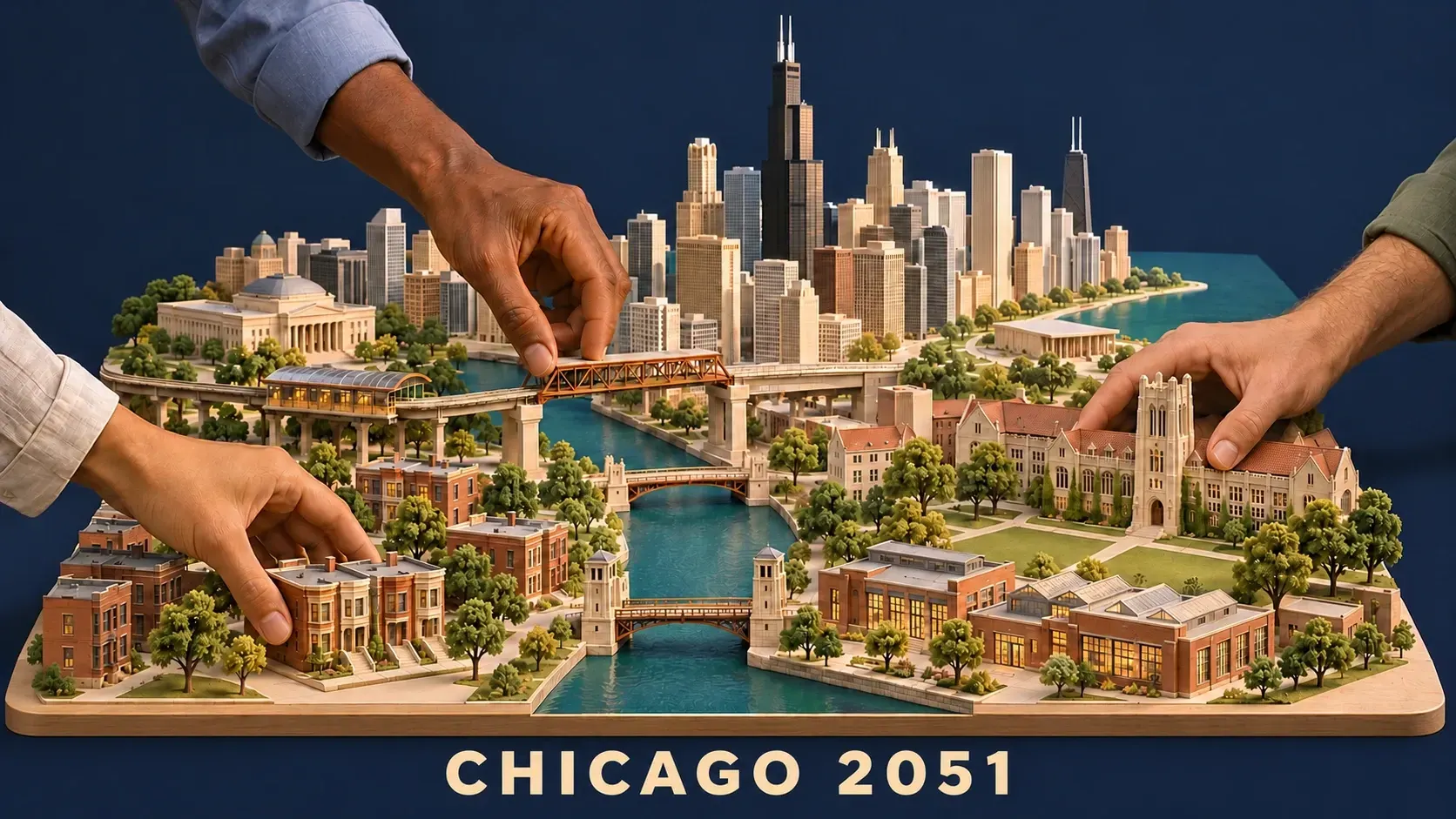
Looking back from 2051 at the transformation of America's Great Lakes capital.
CHICAGO, November 2051 — The Chicago Innovation Awards celebrated their 50th anniversary this week, recognizing another generation of entrepreneurs, researchers and civic leaders whose work has reshaped the city.
Among the evening's most celebrated achievements were the transportation network that transformed travel between O'Hare and downtown Chicago, a university-industry partnership that brought artificial intelligence into everyday healthcare, and community organizations whose innovations helped reverse decades of neighborhood disinvestment.
These aren't actual 2051 award winners, of course.
I'm writing in November 2026, having just attended Chicago Innovation's 25th-anniversary celebration at the University of Illinois Chicago Forum.
But it's worth imagining what we might celebrate 25 years from now.
Because Chicago's future isn't simply a question of which technologies are invented.
It's a question of what we decide to build with them.
A Wrong Turn Toward the Future
Tuesday evening, I accidentally parked at Credit Union 1 Arena rather than the UIC Forum.
The mistake produced a welcome walk across the University of Illinois Chicago campus.
Students moved between buildings beneath the downtown skyline. Research laboratories, classrooms and public spaces occupied a remarkable stretch of urban geography connecting the university with Chicago's commercial center.
Inside the Forum, I joined a community I've chronicled and participated in for much of my professional life—as a journalist, Sun-Times columnist, award winner, judge, moderator and mentor.
The evening celebrated Chicago's innovators, including businesses rooted in neighborhoods such as Humboldt Park.
But walking across campus had me wondering whether the most consequential breakthroughs of the next 25 years might be new ways of connecting the institutions, industries and communities we already have.
The Transportation System We Chose to Build
One intriguing proposal circulating in 2026 is the Chicago Flyer, a privately proposed high-speed connection between O'Hare International Airport and downtown.
Its promise of a 15-minute journey is appealing. But the greater possibility lies in integrating such a connection into a broader transportation vision.
Imagine O'Hare, the Loop, The 78, Union Station, the CTA, Metra and pedestrian networks working together more seamlessly.
Then look beyond Chicago.
Imagine the Great Lakes region connected by transportation that respects how people want to travel.
Sometimes the goal is to arrive in 15 minutes. Other times, a comfortable overnight train—or eventually a reliable autonomous vehicle—could allow people to sleep, work, read or enjoy the journey while someone, or something, else handles the driving.
In 2026, autonomous transportation remains an evolving technology with significant safety challenges. Its eventual capabilities cannot be assumed.
But we shouldn't design tomorrow's infrastructure as though today's technologies and limitations will remain unchanged.
Burnham's Real Gift
Daniel Burnham's 1909 Plan of Chicago helped envision a more beautiful, connected and functional metropolis.
Its enduring achievement wasn't predicting every technological development.
It was establishing a vision ambitious enough to survive developments Burnham couldn't foresee.
Imagine if every transportation decision had been optimized for the horse-and-buggy world of the early twentieth century.
We might have inherited an exceptionally organized version of a city that no longer existed.
The lesson isn't that planning is futile.
Great planning requires a compelling vision and the flexibility to adapt when circumstances change.
Chicago should know what kind of metropolis it wants to become without pretending to know precisely which technologies will take it there.
The Applications Capital
Silicon Valley has earned its reputation as a global center of technological invention and immense wealth creation.
Chicago's greatest opportunity may lie somewhere different.
We are a city of applications.
Our economy spans healthcare, manufacturing, transportation, logistics, finance, agriculture, food, education and public institutions.
What if Chicago became the world's leading example of how emerging technologies can improve those industries while expanding opportunity?
Rather than measuring innovation primarily by venture capital raised or companies sold, we could ask what actually changed.
Did healthcare become more accessible? Did infrastructure become more reliable? Did manufacturers create pathways to better jobs? Did universities prepare people for changing professions? Did public services improve?
And did those benefits reach communities too often excluded from previous waves of economic growth?
Those are worthy measures for the Chicago Innovation Awards of 2051.
Chicago's Triangle Offense
Chicago knows something about extraordinary individual talent.
Michael Jordan was the greatest basketball player of his generation, but the Bulls' six championships also required teammates, leadership and Tex Winter's triangle offense.
The system didn't diminish individual brilliance. It enabled collective excellence.
Chicago's innovation economy needs its own version.
Universities cannot transform the regional economy alone. Neither can corporations, startups, governments, philanthropies or community organizations.
But imagine what becomes possible when these institutions align around common challenges, clear responsibilities and measurable outcomes.
A university research breakthrough connects with an employer prepared to deploy it.
A workforce program responds to actual industry needs.
A transportation investment connects underserved neighborhoods with employment centers.
A public institution adopts technology that improves residents' lives.
And a successful collaboration becomes a repeatable model rather than a one-time celebration.
This is the infrastructure of cooperation.
It may be less glamorous than announcing the next unicorn, but it could prove far more consequential.
The Great Lakes Capital
Chicago possesses advantages that may become increasingly important: freshwater, established transportation networks, major research universities, diversified industries and extensive infrastructure.
As climate pressures influence where Americans live and invest, the Great Lakes could become an increasingly attractive region.
What if we planned for Chicago to accommodate twice its current population?
Not because doubling is a forecast, but because the question challenges the scale of our ambition.
More housing. Better transit. Reliable infrastructure. Stronger connections between Chicago, its suburbs, Northwest Indiana, Urbana-Champaign, Madison, Milwaukee and the wider region.
Most importantly, the South and West Sides must be central to that vision.
A larger Chicago accomplishes little if it simply reproduces today's inequalities at twice the scale.
The objective isn't merely growth.
It's a city that works better for more people.
Back to 2051
Let's return to the imagined 50th-anniversary celebration of the Chicago Innovation Awards.
Perhaps the evening's most celebrated recipients aren't technology companies valued in the hundreds of billions.
Perhaps they're partnerships that transformed transportation, healthcare, education, housing and neighborhood opportunity.
Perhaps the great accomplishment of the previous quarter-century was that Chicago learned to connect extraordinary people and institutions into something more effective than the sum of their individual achievements.
And perhaps the most important innovation wasn't a machine, software platform or laboratory discovery.
It was the system that allowed those inventions to improve everyday life.
That's a future worth planning for.
In 2026, Chicago has the talent, institutions, history and capacity to begin building it.
The next 25 years will reveal whether we found the ambition—and the willingness to work together—to make it real.
Make no little plans.