
The Market for Human Alignment

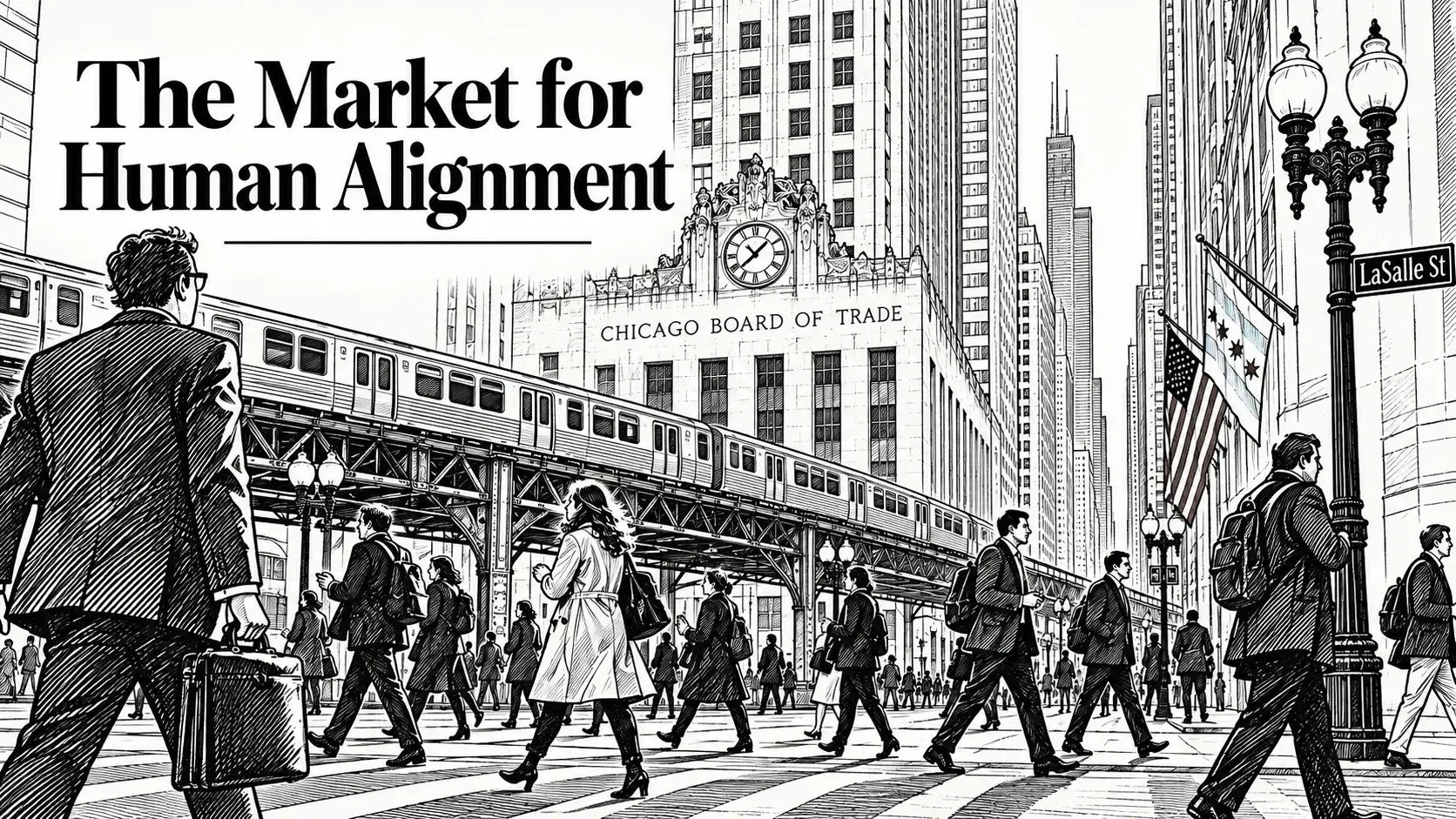
Chicago’s next great exchange may not trade grain, currencies or options. It may help humans figure out how to live with abundance — and with one another.
Something unusual is happening this week.
The United States and China, competitors in just about every category that matters, are talking about artificial intelligence not simply as something one of them needs to win, but as something neither may be able to safely manage alone. American and Chinese officials have agreed to establish a formal AI dialogue that includes an “incident line” for communicating when something dangerous happens.
Think about that.
Two nations that routinely accuse each other of stealing technology, manipulating markets and threatening the other's security are discovering that increasingly autonomous machines may require humans to become a little better at talking to humans.
That may be the most important AI story of all.
The current debate around recursive self-improvement is mostly framed as a technological problem. Ezra Klein recently argued that humans must retain control of the AI frontier rather than allowing machines to increasingly build their own successors faster than humans can understand them.
Fair enough.
But there is a second alignment problem hiding underneath the first.
How do we align artificial intelligence with humanity when humanity is not especially well aligned with itself?
Welcome to Chicago.
Few places are better equipped to contemplate this problem because few cities combine so much institutional abundance with so much institutional fragmentation.
We have world-class universities, national laboratories, financial markets, health systems, corporations, cultural institutions, philanthropies, neighborhood organizations and increasingly enormous public investments in quantum technologies and artificial intelligence.
We also have silos.
Lots of silos.
After almost three decades in Chicago technology rooms, I have learned that collaboration frequently begins with a vigorous discussion about who convened the collaboration.
This is not an indictment of anybody.
It is sociology.
Universities want research funding and prestige. Investors want returns. Entrepreneurs want capital. Government leaders want economic development. Community organizations want their neighborhoods to benefit. Nonprofits want grants. Journalists want stories. Consultants want engagements.
And, if we're being candid, most humans appreciate having their name spelled correctly on the program.
These incentives aren't bugs in civilization.
They're civilization.
The trick is figuring out how to make them work together.
Chicago has done that before through one of humanity's most successful coordination technologies:
Markets.
Markets don't require participants to love one another.
They don't even require them to agree.
A farmer in Iowa and a trader in London don't have to share politics, religion, social class or opinions about the Bears.
They need a price, a contract, rules and enough trust in the system to believe everybody will honor the trade.
That is a profound human invention.
And Chicago got very good at it.
We learned to standardize things that were difficult to compare, attach prices to uncertain futures, move risk from people who didn't want it to people willing to assume it and create clearing mechanisms that allowed strangers with competing interests to transact.
That history may be far more relevant to artificial intelligence than our ability to build another chatbot.
The Discovery Partners Institute's Gene Robinson and Rashid Bashir recently made a thoughtful case that Chicago could become a center for trustworthy AI, even imagining a “Responsible AI — Made in Chicago” designation. Their larger point is that Chicago's unusually diverse real economy gives researchers places to test AI against actual hospitals, manufacturers, workers, financial institutions and communities.
They're right.
The Tribune editorial board is also right that we shouldn't confuse this with the Illinois Quantum and Microelectronics Park. Quantum computing and generative AI are different technologies doing different things, and collapsing everything with a computer chip into one blob called “AI” doesn't help anyone.
But both developments point toward something larger.
Chicago should not merely become a place that builds trustworthy technology.
Chicago should become the marketplace where society learns how to allocate the benefits, risks and disruptions created by technological abundance.
What happens if machine cognition becomes extraordinarily cheap?
Coding becomes cheaper. Research becomes cheaper. Translation becomes cheaper. Analysis becomes cheaper. Pieces of professional work around which millions of people have constructed careers and identities become less scarce.
Value doesn't disappear.
It moves.
Trust becomes more valuable.
Authenticity becomes more valuable.
Human attention, judgment, care, reputation, provenance, physical experience and original culture may become more valuable.
We will need mechanisms for pricing AI risk.
Markets for licensing human intellectual property.
Standards for proving where information originated.
Insurance products around autonomous systems.
Contracts defining how workers participate in productivity gains.
New methods of making sure neighborhoods surrounding publicly supported technology investments acquire something more tangible than an invitation to the ribbon cutting.
And we will need markets and institutions we haven't imagined yet.
This is why the Commercial Club's new Growth for All report is a useful accent to this discussion rather than its destination. The Club acknowledges that a region loaded with assets has nevertheless lagged peer metropolitan areas in population and economic growth, ranking 15th of 15 peers in population growth and 14th in real metropolitan output growth since 2010. Its proposed response includes what it calls a “One Table” model bringing business, government, civic and community interests together.
“One Table” sounds almost quaint in an era of recursive artificial intelligence.
It may also be exactly right.
Not because everybody sitting around it will suddenly agree.
They shouldn't.
Markets work precisely because participants have different interests.
The goal is to create rules under which those interests can produce something larger than themselves.
Daniel Burnham's great civic achievement wasn't discovering Chicagoans without egos. Such a population has yet to be located.
His achievement was helping competing institutions imagine that a greater Chicago could be worth more than the individual pieces each could control.
Our version needs to be vastly more inclusive than the civic leadership of 1909. It needs the South and West sides. It needs labor. Artists. Teachers. Technologists. Entrepreneurs. Insurers. Universities. Neighborhood organizations. Government. Business.
Not because representation looks nice in a photograph.
Because every one of those groups owns part of the information necessary to price the future correctly.
That is the sociological challenge confronting DPI, IQMP, the University of Illinois, University of Chicago, mHUB, Argonne, Fermilab, investors, state government and the rest of Chicago's innovation constellation.
Nobody needs to surrender institutional ambition.
But nobody can mistake their institution for the ecosystem.
Artificial intelligence changes the urgency.
The internet promised to connect humanity and often succeeded at connecting us into smaller groups exceptionally skilled at yelling at one another.
AI could magnify that fragmentation.
Or cognitive abundance could give individuals and small organizations enough agency to cross institutional boundaries that previously seemed immovable.
That choice remains ours.
If Washington and Beijing can conclude that some machine risks are sufficiently consequential to require new human communication, Chicago should be capable of a similar realization closer to home.
Our next great export doesn't have to be another platform.
It could be a model for human alignment.
A trusted marketplace connecting technological abundance to human opportunity.
Silicon Valley can build increasingly intelligent machines.
Chicago should help build the rules by which humans live with them — and, perhaps more importantly, with each other.
We've been clearing trades between competing interests for 175 years.
This one just happens to be about the future of being human.