
SHAKE ’ER UP ’ER…


Or: How I Learned to Stop Worrying and Love the Q-Bomb
Chicago is making one of the largest frontier-industry bets in its history. The people making it may even be right. Project Middle Ground would simply like somebody to explain the plan to the rest of us.
Chicago has entered its Stanley Kubrick period.
There are machines most of us don't understand.
Government officials assuring us that the stakes are enormous.
Very smart people discussing civilization-changing technology in rooms most civilians will never enter.
Hundreds of millions of public dollars.
Billions more potentially following them.
National security.
Private capital.
Public subsidy.
Academic eminence.
Some Eyes Wide Shut invitation lists.
A little Clockwork Orange brain elasticity required simply to understand what a qubit is.
And, hanging over the entire production, Dr. Strangelove:
Don't worry. We need this. The other guys are building it too.
The disquieting part?
They may be right.
And that is precisely why the rest of us deserve to understand what is happening.
Somewhere in Quantum…
Your correspondent spent part of this week somewhere inside Chicago's expanding quantum-industrial complex.
Where?
Nice try.
Some of the week's conversations occurred under the Chatham House Rule, which allows participants to use information they receive while protecting the identities and affiliations of the people who supplied it. It is designed to make candid conversation possible.
So we'll honor it.
Diabolically.
People become composites. Places become metaphors. Opinions detach from business cards.
Think Homer.
Think Jerry.
Think Bobby.
Think the Hero's Journey, except Odysseus has a Series A deck and is looking for another 18 months of runway.
Separately—and very much publicly—Hyde Park Labs hosted a sold-out Economic Club of Chicago Member Exchange on “AI, Quantum and the Global Innovation Race,” moderated by Samir Mayekar with University of Chicago leaders Nadya Mason and David Uminsky. Members were shown startup labs and multiple quantum computers.
It is difficult to walk through the place and not be impressed.
That is worth saying without a wink.
There is intellectual firepower. There is capital. There is institutional confidence. There is the particular University of Chicago ability to suggest, not entirely without evidence, that whatever everyone else is doing, they have figured out a more interesting way to do it.
And they're hardly alone.
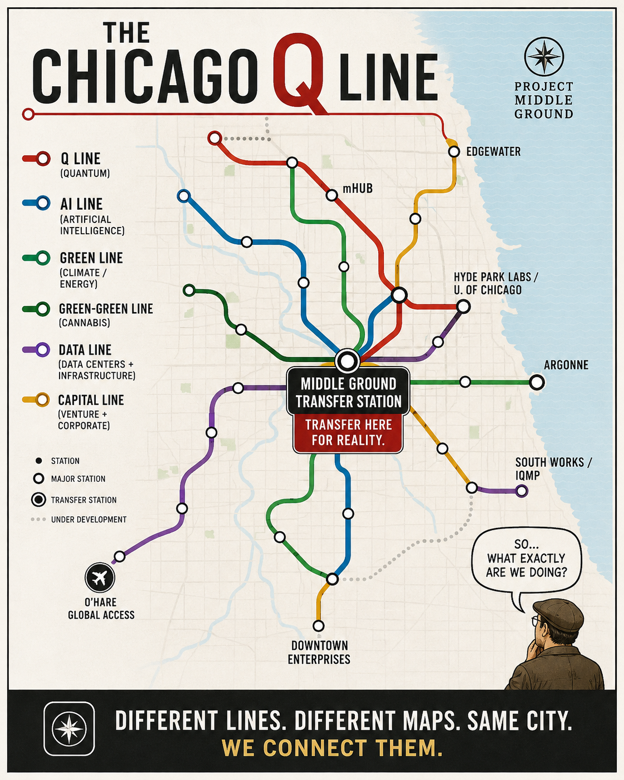
Move around Chicago's emerging frontier-industry map and you encounter mHUB, the universities, Argonne, Fermilab, Chicago Quantum Exchange, startups, multinational corporations and, looming largest of all, the Illinois Quantum and Microelectronics Park at the old U.S. Steel South Works site.
Illinois has committed $500 million to infrastructure and facilities at that campus, after previously putting substantial state resources behind the broader quantum ecosystem.
This isn't another incubator ribbon cutting.
It is industrial policy.
Dr. Strangelove, Meet Uncle Sam
Washington has now made that unmistakable.
In May, the U.S. Department of Commerce announced planned quantum investments approaching $2 billion across nine companies, including proposed $100 million awards to both Infleqtion and PsiQuantum. And here's the wonderfully 2026 twist: Commerce says the United States will receive minority, non-controlling equity stakes in the companies receiving those incentives.
Uncle Sam, venture capitalist.
Donald Trump and J.B. Pritzker, whatever else they may think of one another, now operating inside portions of the same emerging quantum economy.
Public money.
Private companies.
Government equity.
National security.
Commercial upside.
Maybe Kubrick was an optimist.
Earlier this summer, Pritzker sat down with Kara Swisher at the second Global Quantum Forum in Chicago to discuss Illinois' attempt to stake a claim in the global quantum race. The event itself was a remarkable assembly of government, science, business and capital organized by P33 and Illinois EDC around the premise that Illinois can become one of the global centers of this industry.
Again:
Maybe they're right.
That is important.
Project Middle Ground is not approaching quantum from the comfortable position that government investment is inherently foolish, universities are self-serving, capitalism is corrupt or technology will inevitably destroy civilization.
Nor are we ready to join the pep rally.
The interesting place is in between.
What If the Hawks Are Right?
There is a tendency in civic discourse to make every emerging technology debate binary.
Booster or skeptic.
Growth or regulation.
Innovation or caution.
America or China.
Capitalism or government.
Yes, and.
What if quantum really does become strategically important to computing, sensing, communications, materials, medicine, cryptography and national defense?
What if the United States genuinely cannot afford to wake up 15 years from now and discover that a strategic capability migrated somewhere else while we were waiting for conventional venture economics to make sense?
What if Illinois happens to possess an unusual combination of universities, laboratories, scientists, corporations, infrastructure, political will and money that gives us a legitimate opportunity to lead?
Then government probably should be involved.
And if the stakes are truly national-security scale, the normal timelines and risk tolerances of private investment may indeed be insufficient.
There's your Dr. Strangelove problem.
The argument can be both consequential and correct while still deserving scrutiny.
Robert McNamara was once a member of America's celebrated class of “best and brightest.”
Methodology mattered.
Data mattered.
Winning mattered.
Then reality demonstrated that very intelligent people operating inside internally coherent systems can become extraordinarily confident in assumptions that outsiders might have questioned.
Smart people aren't the problem.
A system in which only smart insiders understand the assumptions can be.
Chicago's Quantum Cabinet
Illinois has now assembled what amounts to a quantum cabinet.
Scientists.
University presidents and deans.
Venture investors.
Corporate executives.
Economic-development professionals.
Federal officials.
State officials.
Consultants.
Real estate.
Infrastructure.
Utilities.
Startups.
Everybody seems to know everybody.
Everybody has a deck.
Everybody has a map of the ecosystem.
And almost everybody involved professionally has some reason to believe that more investment in the ecosystem is a good idea.
Again: they may be correct.
But here is the question that keeps nagging at this particular scribe:
Where is the citizen in the deck?
Not as the worker in slide 37.
Not as the disadvantaged community benefiting from an arrow pointing toward “inclusive growth.”
Not as a taxpayer.
Not as a voter.
As a participant capable of understanding the wager well enough to decide whether she supports it.
The 99 Percent Quantum Problem
For perhaps 99 percent of Illinois residents, “quantum” currently means one of approximately four things:
Something Einstein did.
A computer that is somehow extremely fast.
A technology stock somebody's brother-in-law says they should buy.
Or Ant-Man.
This is not the public's failure.
It is the industry's communications failure.
The people spending public money on quantum should be able to explain the wager without requiring the listener to understand quantum mechanics.
The people seeking private capital should be able to distinguish genuine commercial progress from beautiful presentations involving atoms.
Universities should be able to tell us where discovery becomes enterprise.
Politicians should be able to describe success using something other than the words ecosystem, hub, world-class and transformational.
And journalism should be doing considerably more than repeating those words.
At a recent quantum-related press availability, I watched reporters receive a precious few minutes with Illinois' governor.
There were plenty of cameras.
There were questions about the day's Springfield political controversies.
There were questions about the Bears.
Perfectly legitimate subjects.
But somewhere between the ethics question and the stadium question sat an enormous public wager on a technology most Illinois residents cannot define.
Where was:
Governor, what exactly does victory look like?
Or:
How will taxpayers know five years from now whether this worked?
Or:
If quantum companies leave after receiving incentives, what does Illinois retain?
Or:
How much continuing federal support does the model require?
Or:
What does somebody living five miles from South Works get out of this?
Or perhaps simply:
Can you explain the plan?
Follow-up questions are among journalism's most renewable resources.
We should use them.
More Huxley Than Orwell
For years, people trying to understand technology's implications have reached reflexively for Orwell.
Big Brother.
Surveillance.
Centralized control.
The state knows everything.
But the emerging world feels increasingly Huxleyan.
Nobody needs to hide the important information.
There is too much information.
Everybody gets a screen.
Everybody gets a feed.
Everybody gets content optimized for their existing interests.
The investor gets quantum valuations.
The physicist gets papers.
The politician gets job projections.
The neighborhood gets renderings.
The taxpayer gets a press release.
The journalist gets a 15-minute availability.
And the rest of us get distracted.
No Ministry of Truth required.
Just excellent catering and push notifications.
The Machines Have a Cousin
Quantum is also arriving as artificial intelligence races ahead of the institutions supposedly governing it.
Its corporate cousin AI requires enormous new infrastructure: power, land, chips, data centers, transmission and, depending on the technology and location, significant water and cooling resources.
That means these are no longer merely “technology stories.”
They are stories about:
Energy.
Land use.
Labor.
Education.
Water.
National security.
Public finance.
Tax incentives.
Economic mobility.
Neighborhood development.
Concentrations of corporate power.
And eventually politics.
The frontier-industries conversation therefore cannot belong solely to frontier-industry people.
With great power comes great responsibility.
Even Spider-Man understood the governance model.

All Work and No Follow-Up Questions…
Eventually we arrive at The Shining.
Chicago has been here before.
Honey, I'm home.
We produce extraordinary intellectual assets.
We build institutions.
We make discoveries.
We train people.
And then, often enough, somebody somewhere else captures an enormous portion of the resulting enterprise value.
Illinois' current quantum strategy is explicitly intended to avoid repeating that pattern.
That is a legitimate—and potentially brilliant—strategy.
So let's measure it.
Not someday.
Now.
Before everybody decides it worked.
The Three-Clock Test
Project Middle Ground proposes something radical:
A scoreboard.
If Chicago and Illinois intend to become indispensable to the quantum economy, describe success on three clocks.
Six months
What should residents be able to see that they cannot see today?
Companies recruited?
Capital committed?
Facilities under construction?
Students entering training?
Corporate customers experimenting with quantum?
Neighborhood businesses receiving contracts?
New research moving toward commercialization?
Federal milestones achieved?
Don't tell us quantum will change everything.
Tell us what should change next.
Five years
Now the scoreboard gets harder.
How many meaningful quantum companies are headquartered here?
How many started here?
How many stayed here?
How much private capital followed the public capital?
What percentage of the ecosystem remains dependent on subsidy?
How many jobs exist—and what kinds?
What pathways exist for somebody who doesn't possess a physics doctorate?
What intellectual property is being commercialized here?
How much enterprise value does Illinois retain?
And what measurable economic benefit has reached the South and West sides?
Twenty-five years
This is the Burnham clock.
Forget “hub.”
Every city in America with a university and a co-working space now calls itself a hub.
What does Chicago own?
What does Chicago lead?
What is something the global economy cannot do without Chicago?
Did quantum create a new industrial base?
Did we build companies?
Did the universities participate economically in the companies their ideas produced?
Did Chicago become the place where frontier technology is translated into practical enterprise?
Did the wealth spread?
Did our children stay?
Did global talent come here?
And did the public investment create something durable enough to survive the politician whose name appeared on the original press release?
Those seem like useful questions.
The Political Superposition
There is another reason to establish the scoreboard now.
Credit is coming.
Lots of it.
The governor will understandably claim quantum as part of his economic-development record.
Former officials will remember their role in creating the conditions.
Universities will point to foundational science.
Economic-development organizations will point to recruitment.
Investors will point to risk capital.
Washington will point to federal dollars.
Republicans will point to national security.
Democrats will point to industrial policy.
And future Chicago mayoral candidates will explain why their particular combination of government, business, equity and growth represents the missing ingredient.
In quantum terms, the authorship of the Chicago ecosystem may remain in superposition until somebody runs for something.
Fine.
Politics is politics.
But the public needs a ledger before the campaign literature arrives.
This Is Not an Anti-Quantum Column
Quite the opposite.
If this were obviously nonsense, Project Middle Ground wouldn't find it particularly interesting.
The harder possibility is that Illinois has made an unusually smart bet.
The state has allocated $500 million toward IQMP infrastructure and R&D facilities. Washington is simultaneously deploying very large sums into quantum companies, including firms connected to Illinois' emerging ecosystem, while taking equity stakes intended to provide taxpayers some participation in upside.
Serious people are taking this seriously.
That's the story.
And seriousness requires more than belief.
It requires questions.
Scrutiny Without Sabotage
This is the territory Project Middle Ground wants to occupy.
Not:
Quantum is a boondoggle.
Not:
Quantum will save Chicago.
Instead:
Show us.
Show us the public-private bargain.
Show us the commercial pathway.
Show us the national-security case.
Show us where the risks are.
Show us the milestones.
Show us who gets paid.
Show us who owns what.
Show us what happens if Washington's priorities change.
Show us what neighborhoods gain.
Show us what the universities retain.
Show us what taxpayers receive.
And show us how we will know when we were wrong.
That isn't cynicism.
That's citizenship.
Who You Gonna Call?
Which brings us to the inevitable commercial portion of this public-service announcement.
Yes, somebody is trying to sell you something.
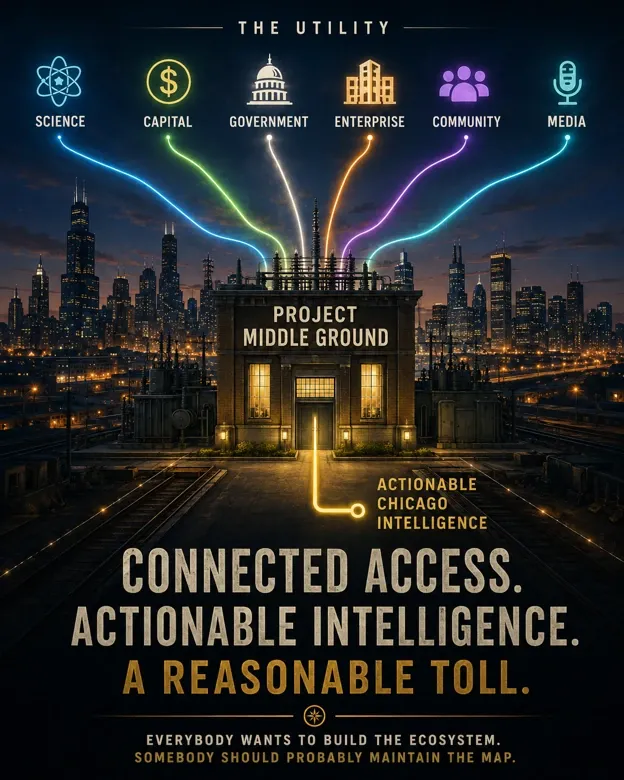
Project Middle Ground is a Chicago-based civic infrastructure utility with roots in chronicling frontier industries going back roughly to the Clinton Administration.
We've seen the Internet arrive.
We've watched mobile swallow it.
We've watched social media convert participation into engagement metrics.
We've watched cannabis move from counterculture to balance sheet.
We've watched AI move from Gartner slide to existential conversation faster than most institutions could schedule the committee meeting.
And now we have quantum.
Our proposition isn't that we know more quantum physics than quantum physicists.
Lord help us if that's the standard.
Our proposition is that somebody needs to see the whole field.
Government.
Science.
Capital.
Industry.
Media.
Neighborhoods.
Workers.
Consumers.
Students.
Taxpayers.
Voters.
And occasionally the human soul, which has so far proven stubbornly resistant to inclusion in an Excel workbook.
Project Middle Ground exists to translate among them.
To convene them.
To ask the question after the prepared answer.
To distinguish opposition from accountability.
And perhaps to give the 99 percent of people outside the room enough information to decide whether they want to enter it.
Optimism Without Obedience
Chicago should make big bets.
Burnham would be bored senseless by incrementalism.
And a city that wants a role in the next 25 years of the global economy cannot wait until technologies are risk-free, comprehensible and already dominated by California.
So:
Make the quantum bet.
And explain it.
Take the federal money.
And account for it.
Recruit the companies.
And measure what remains after the incentives.
Celebrate the scientists.
And introduce them to the citizens underwriting the ecosystem around them.
Compete with China.
And still ask questions about the machinery we're building to do it.
Because the most dangerous civic choice isn't optimism.
It's obedience disguised as optimism.
Project Middle Ground prefers:
Scrutiny without sabotage.
Optimism without obedience.
Capitalism with a scoreboard.
Public investment with a public explanation.
Chicago's quantum establishment may be absolutely correct that this is one of those rare moments when the city's universities, government, capital, geography and industrial history align around an opportunity capable of changing its trajectory.
Great.
Yes, and…
Where are we going?
Where should we be six months from now?
Five years from now?
Twenty-five years from now?
What does victory look like?
And who is responsible for calling the play when the original one breaks down?
If we're going to learn to stop worrying and love the Q-Bomb, the least somebody can do is tell the rest of us what we're hoping it blows open.
And what Chicago intends to build afterward.
Project Middle Ground
Frontier Industry. Civic Translation. Follow-Up Questions.