
The Middle Ground Between Quantum and the Bears

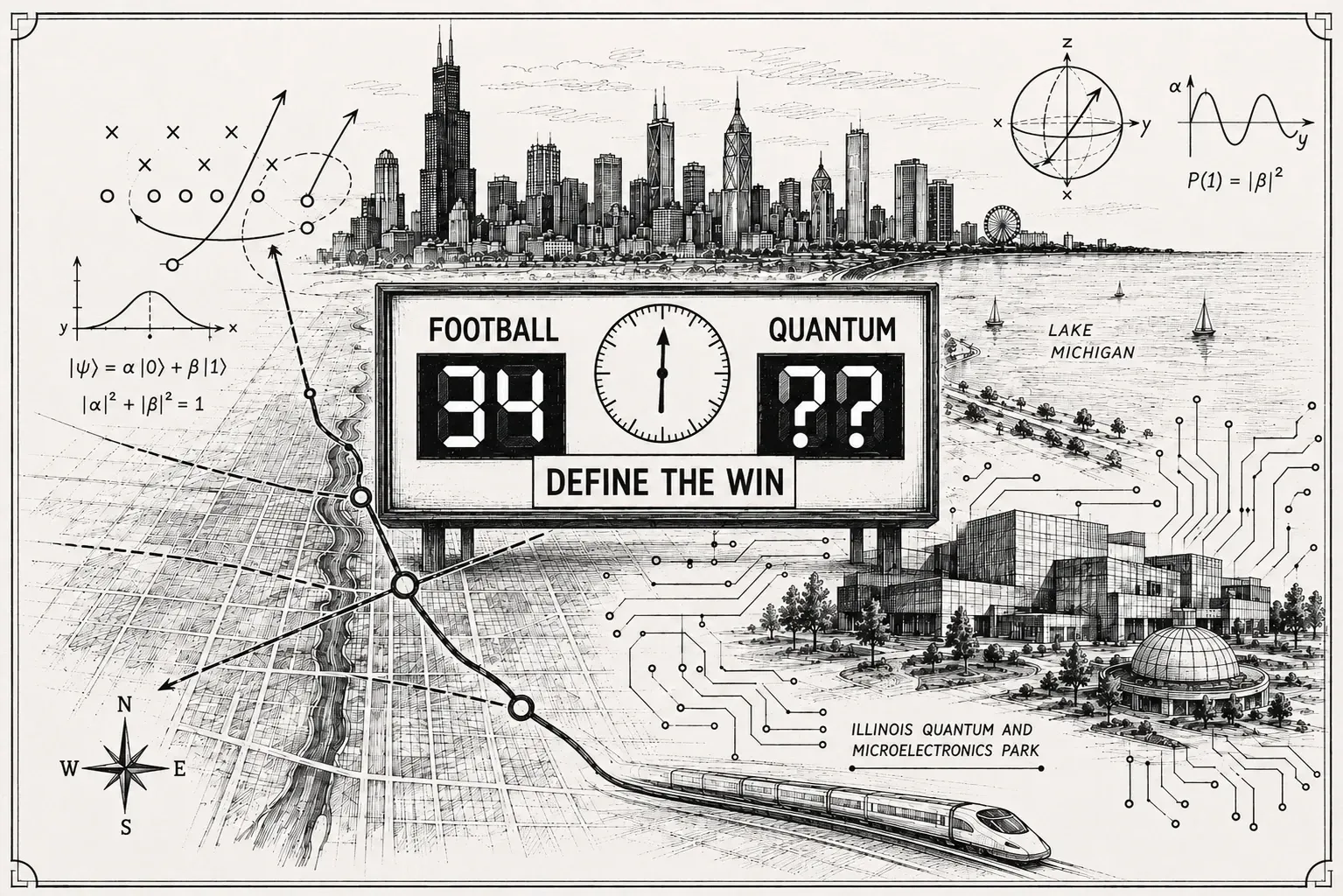
Chicago knows how to demand a championship from its football team. We need an equally legible scoreboard for a half-billion-dollar bet on the future of computing.
I am a Chicago Bears meatball.
Not recovering.
This is not an insult. It is an inherited emotional operating system: Bears all the way, all the time, even when available evidence suggests that more adaptive technology may have been installed elsewhere.
The useful thing about being a Bears fan is that the standard is remarkably clear.
Win the Super Bowl.
Make the playoffs and lose? Nice season.
Win the division? Hang the banner, enjoy the week and continue working.
Deliver inspiring press conferences, improved culture, high character and encouraging performance indicators? Wonderful. Now win the Super Bowl.
Sports fans understand that leaders do not get to redefine victory merely because the journey has been difficult or the presentation deck looks unusually good.
That is what makes the Bears useful as a civic measurement device.
A Championship Is an Actual Thing
The 2025 Bears gave us legitimate reason to believe.
In Ben Johnson’s first season as head coach, they finished 11–6, won the NFC North, beat the Packers in the playoffs and came within an overtime possession of reaching the NFC Championship Game. Caleb Williams set a Bears single-season record with 3,942 passing yards and helped engineer seven victories in games the team trailed during the final two minutes.
That is not mythology. That is progress.
It also does not require us to become stupid.
The Bears enter Johnson’s second season with exceptional offensive potential and identifiable weaknesses. Williams may possess Jordanesque qualities, but the comparison remains an aspiration rather than an achievement. Rome Odunze remains more promise than finished product after an injury-limited second season. Left tackle is unsettled. The offensive line, edge rush, defensive interior and safety depth remain legitimate questions. Even the NFL’s own draft analysis identified offensive line, edge and defensive line among the team’s needs.
This is how serious participation works.
We can believe in Ben Johnson, Ryan Poles and Caleb Williams while still examining the roster. We can appreciate a plan while asking whether it has sufficient people, protection, depth, capital and time to work.
We have, after all, been burned before.
The post-Ditka Bears have repeatedly invited us to admire the pieces. The city still loves Dave Wannstedt, but Chicago does not need another civic version of “we have all the pieces.”
Pieces are not a championship.
Alignment is not execution.
Potential is not victory.
The Public Is Already in the Game
The Bears are not merely a private entertainment company.
They are a regional institution advancing a stadium project with substantial implications for land, infrastructure, transportation, taxes and public identity. In June, the Bears’ board voted to advance the stadium project in Hammond, Indiana, with the precise site still to be selected. The organization explicitly framed it as a regional undertaking connecting Northwest Indiana, Chicago’s South Side, the Loop and the broader metropolitan area.
That makes the rest of us more than fans.
We are emotional stakeholders, economic participants and—depending on the final stadium arrangements—potential public benefactors.
It is therefore reasonable to ask the Bears to define the win.
What is being built?
Who pays?
Who benefits?
What risks are being assumed?
What happens if the expected economic activity does not materialize?
And, most importantly, will Caleb have enough time to throw the football?
These are not anti-Bears questions.
They are Bears questions asked by people who want the Bears to win.
Which brings us, naturally, to quantum computing.
The Quantum Governor Has Assembled a Roster
Illinois has committed $500 million over five years to infrastructure and research facilities at the Illinois Quantum and Microelectronics Park on Chicago’s South Side, following an earlier $200 million state commitment supporting the Chicago Quantum Exchange. PsiQuantum’s state incentive agreement calls for at least $1.09 billion in company investment and 154 full-time jobs. IBM is bringing a quantum system to the park and has announced a Chicago center expected to create 750 jobs spanning quantum, AI, cybersecurity and data science. Illinois also secured approximately $30 million in new federal funding for the Bloch Quantum Tech Hub.
These are significant achievements.
They are not imagined. They are not merely panels about the possibility that, with sufficient alignment, Illinois may one day consider forming a working group.
The capital is real.
The companies are real.
The scientific institutions are real.
The national-security implications are real.
The political attention is real.
The roster is becoming impressive.
At the 2026 Global Quantum Forum, P33 and the Illinois Economic Development Corporation assembled more than 60 speakers from government, industry, universities and global institutions around a program explicitly focused on quantum’s potential effect on medicine, energy, cybersecurity, economic development and other grand challenges.
It was a very good room.
It may have been the most consequential room assembled during Chicago’s modern technology era.
It was still a room.
A Billion Dollars Is No Longer a Complete Sentence
The marquee conversation paired Governor J.B. Pritzker with Kara Swisher, the leading technology interviewer of her generation and someone I have admired long enough to feel comfortable describing what happened.
Pritzker invoked the billion-dollar scale surrounding Illinois’ quantum commitment as evidence of seriousness.
Swisher responded, in substance:
That may not be enough.
It was not a takedown. It was the assignment.
A billion dollars is objectively a large amount of public and private money. But “one billion dollars” is not, by itself, a measurement of global competitiveness.
Compared with what?
Compared with the capital being deployed in California, New York, Massachusetts, Colorado, Europe, Canada, Australia or China?
Compared with what IBM, Google, Microsoft or a single well-financed quantum company may invest?
Compared with batteries, electrification, biotechnology, healthcare, education, cannabis or other opportunities competing for Illinois capital and executive attention?
Compared with the cost of succeeding?
Or the cost of almost succeeding?
The real significance of Swisher’s response was not that Illinois should spend more money.
It was that the number requires context.
The Chicago Scoreboard
Project Middle Ground has started assembling a deliberately blunt measurement of Chicago’s modern innovation economy:
How many Chicago-area technology companies have produced IPOs or acquisitions valued at $1 billion or more?
Our initial count is 32.
Thirty-two grand slams.
Morningstar. Groupon. U.S. Robotics. NAVTEQ. CDW. Molex. AveXis. Grubhub. Tempus. Cleversafe. Fieldglass. Sprout Social. And others.
Every one is a Chicago victory.
They represent founders taking risks, employees building companies, investors committing capital and institutions helping ambitious people find one another.
They also leave a question:
Is 32 a lot?
The answer cannot be “yes” merely because 32 is more than zero or because the names fit attractively onto a website.
We need to compare Chicago with the San Francisco Bay Area, New York, Boston and Cambridge, Austin, Seattle, the Colorado Front Range and relevant global clusters using the same rules, dates and geographic definitions.
Chicago has experienced the alternative.
Mosaic was created at the University of Illinois by Marc Andreessen, Eric Bina and colleagues. Andreessen then moved west to commercialize the work through Netscape, whose 1995 public offering became a defining moment of the commercial internet.
That history is both a triumph and a wound.
Illinois helped invent the future.
Somebody else became its primary owner, storyteller and beneficiary.
Quantum is supposed to be different.
Define the Quantum Championship
Rashid Bashir, dean of The Grainger College of Engineering at the University of Illinois Urbana-Champaign and vice chancellor for Chicago strategic partnerships, offered both the best joke and the clearest framing I heard during TechChicago Week.
J.B. Pritzker is the Quantum Governor, Bashir joked, because he can exist in multiple places at the same time.
Bashir also described what is at stake as the future of computing and framed Illinois’ undertaking less as a moonshot than a Mars shot. His institutional role now explicitly bridges Urbana-Champaign’s research capabilities with Chicago’s emerging opportunities.
A Mars shot is a useful metaphor because Mars is far away, expensive and surrounded by unresolved questions.
Who gets to go?
Why are we going?
What are we building along the way?
What opportunities are deferred while the spacecraft is constructed?
And what constitutes arrival?
Illinois cannot meaningfully “win quantum” until it defines the championship.
A credible scoreboard might include:
- Intellectual property created and retained in Illinois.
- Companies formed, scaled and headquartered here.
- Private capital attracted for every public dollar committed.
- Research translated into products and paying customers.
- Illinois suppliers participating in the resulting industrial base.
- Jobs created for technicians, operators, educators and service providers—not only physicists and Ph.D.s.
- Teachers and institutions equipped to prepare people for those jobs.
- Economic and civic value created for South Side communities surrounding the quantum park.
- Publicly understood protections involving cybersecurity, energy, environmental impact and national security.
- Chicago becoming the place where the world comes not only to discuss quantum, but to purchase, deploy and govern it.
Jobs matter.
But an employment projection alone is not a championship.
A tenant announcement is not a championship.
A global conference is not a championship.
A ribbon-cutting is definitely not a championship, although Chicago remains undefeated in ribbon-cutting.
The Word “Weapons” Has Legs
Football teams need weapons.
Quarterbacks need receivers, tight ends, running backs and protection.
Quantum’s emerging relationship with national security makes the word less metaphorical. Quantum is simultaneously science, computing architecture, advanced manufacturing, economic development and strategic infrastructure.
What exactly is Chicago becoming?
A computing center?
A manufacturing cluster?
A national-security and defense-technology hub?
A research park?
A real-estate development?
A workforce initiative?
The answer may be all of the above.
But each answer produces a different stakeholder map, risk structure and definition of public value.
If quantum is partly a national-security project, who communicates that to residents?
If it is an economic-development project, which economic outcomes are contractually expected?
If it is an education project, who is preparing teachers?
If it is a South Side development project, how are neighboring communities participating before—not after—the important decisions are made?
And if it is the future of computing, how many people inside Illinois can explain what that sentence means?
What We Heard Beneath the Table
On March 31, Project Middle Ground convened Quantum and the Common Good at mHUB.
Twenty-five collidingly cautious people participated across research, industry, education, workforce development, civic leadership and communications.
They did not reveal a single ideological conflict that could be solved by another panel.
They revealed something more foundational.
The people pursuing the same future often use different language, operate on different timelines and report to different definitions of success.
Researchers speak in scientific milestones.
Companies speak in products, capital and competitive advantage.
Government speaks in investment, jobs and national leadership.
Educators speak in curriculum, access and preparation.
Communities speak in trust, inclusion and whether promises will reach their families.
Journalists need an intelligible story.
None of these perspectives is illegitimate.
None is sufficient alone.
That is the middle ground.
Not compromise for its own sake.
Not splitting every disagreement precisely down the center.
The middle ground is the shared operating space where the people invested in an outcome can hear what the others actually mean, test the assumptions beneath the official language and build a roadmap with visible responsibilities.
Fans Are Participants
The Bears do not need fans to understand every protection scheme.
They do need us to understand the season, recognize the stakes and hold the organization to a championship standard.
Quantum scientists do not need every Illinois resident to understand error correction, cryogenics or the competing architectures of quantum computing.
Illinois does need enough public understanding for people to evaluate what is being financed, identify opportunities, question tradeoffs and participate in the future being built on their behalf.
That participation cannot begin after the appropriations, incentive agreements, land-use decisions, institutional partnerships and workforce strategies are complete.
The public is not the audience for the plan.
The public is part of the team.
Quantum Is the New Bears
Quantum is the new Bears not because both involve expensive equipment, mysterious terminology and institutions asking the public to remain patient.
It is because both are civic mythologies carrying real expectations.
Both ask us to believe.
Both ask us to invest.
Both operate across generations.
Both can produce moments when Chicago sees itself not as the city that almost became something, but as the place that achieved greatness on its own terms.
I believe in Ben Johnson.
I believe Caleb Williams may be special.
I believe the Pritzker administration and Illinois’ scientific institutions have placed us in a quantum position that did not exist a few years ago.
I also believe that affection without standards is how Chicago gets burned.
So let us celebrate every company, grant, scientist, student, construction worker, executive, public official and community partner moving this work forward.
And let us define the championship.
Project Middle Ground is beginning with one question:
What must Illinois be able to point to by 2030 and truthfully say: this is what our quantum bet produced?
Help us build the scoreboard.
Help us find the holes in the roster.
Help us invite the right people into the room.
Help Chicago understand the future it is financing, participate in the future it is building and retain more of the future it has repeatedly invented for everyone else.
Bear down.
Define the win.
And if we are building a quantum coast on the South Side and a Bears stadium in Hammond, somebody should probably put high-speed rail on the whiteboard.