
WELCOME TO THE MACHINE. NOW READ THE BOOK.

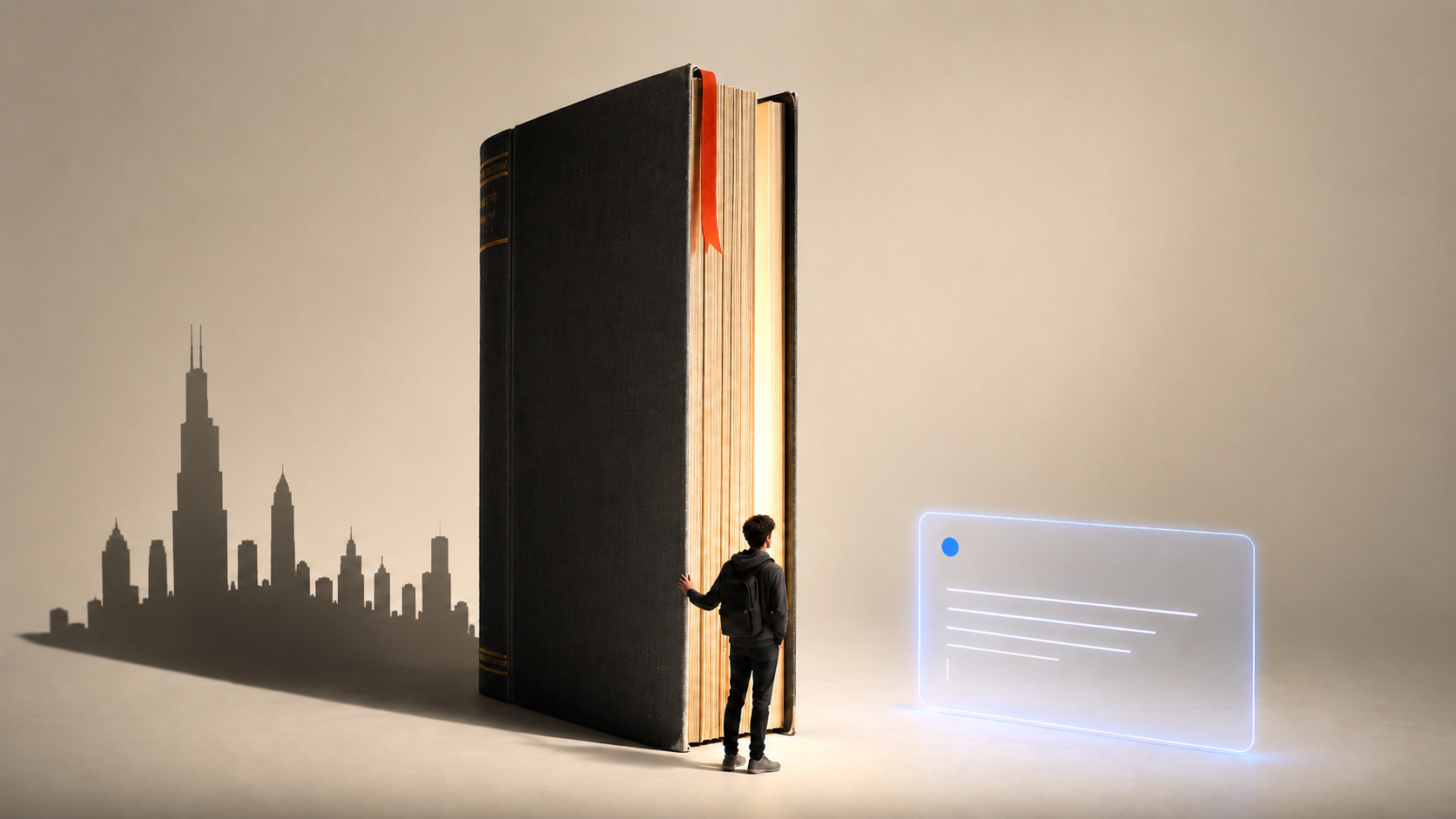
What Artificial Intelligence Makes More Human—and More Necessary.
Before Chicago conquers AI, quantum and the other frontier industries, perhaps we should make sure the humans can still finish 300 pages without asking a machine what happened.
Nearly two decades ago, Katie Couric asked Republican vice-presidential candidate Sarah Palin a question that became one of the defining little moments of the 2008 presidential campaign.
Not about Russia.
Not about derivatives.
Not even about the collapsing financial system.
Couric asked which newspapers and magazines Palin regularly read to understand the world.
Palin struggled to name one.
It became a Rorschach test.
If you supported Palin and John McCain, there was a decent chance you regarded the exchange as another example of elite media laying a trap for a candidate it didn't particularly like.
If you supported Barack Obama—or occupied a considerable portion of the middle—the reaction was closer to:
Wait. That's the gotcha question?
Name something you read.
Anything.
In those salad days of 2008, before social media had completely colonized the attention of our best and brightest, it still seemed reasonable to believe that somebody seeking one of the most consequential jobs on Earth should be able to identify the journalism she consumed.
The question itself presumed something almost quaint:
Leaders read.
Roxanne, those days are over.
Welcome Back to School
K-12 education is currently being reinvented in real time by artificial intelligence.
Teachers are experimenting.
Students are experimenting considerably faster.
Parents are confused.
Administrators are writing policies.
Trustees and school boards are asking questions.
Technology companies are providing answers, frequently attached to invoices.
Employers are simultaneously telling schools that tomorrow's workers will need to understand these tools.
The federal education research apparatus itself describes states and districts as actively experimenting with AI for teaching, personalized learning, feedback and decision-making while the evidence base is still emerging.
So what exactly constitutes cheating?
If a student asks an LLM to summarize a chapter, did she learn?
If he uses AI to improve an essay, is that editing?
If the employer he joins four years later expects him to use exactly that technology to compose a memo in 45 seconds, was the school preparing him for work—or preventing him from learning how to think?
What is authorship?
What is research?
What is original thought?
What is trust?
And who gets to decide?
Nobody has a common operating system yet.
Students don't.
Teachers don't.
Parents don't.
Administrators don't.
Public-school systems don't.
Private schools don't.
Catholic schools don't.
Employers certainly don't.
That is not necessarily failure.
It means we're early.
But while everybody is trying to figure out what artificial intelligence means for education, another problem has been sitting right in front of us.
Kids aren't reading much.
No, Really. They're Not.
The numbers are not subtle.
In 1984, 35 percent of American 13-year-olds told the National Assessment of Educational Progress that they read for fun almost every day.
By 2023?
Fourteen percent.
And the 2024 national reading results brought more bad news: eighth-grade scores fell again from 2022, with particularly troubling declines among lower- and middle-performing students.
We can argue about causation all day.
Phones.
Social media.
Pandemic disruption.
Teaching methods.
Family structure.
Curriculum.
Attention.
Testing.
Economics.
Politics.
Probably all of the above, plus things we have not yet identified.
But surely we can agree on something simpler:
Abandoning sustained reading is not a winning strategy.
Sorry.
That's stupid.
Not people being stupid.
A system making a stupid decision.
Because books possess an almost embarrassingly effective technological feature:
They make you stay.
Black ink.
White page.
Next page.
And another.
No notification.
No autoplay.
No comment section.
No algorithm informing you that someone you vaguely remember from 2006 just liked something.
A book asks your brain to remain inside somebody else's architecture long enough to understand where the building goes.
Sometimes you don't like the building.
Good.
Stay anyway.
I Didn't Read All the Damn Books Either
Full disclosure.
I am dyslexic.
I did not spend my own high-school and college years blissfully consuming every great work assigned to me.
I faked some of it.
Probably more than some.
Patient teachers sometimes let me approach ideas through other media. Robert Johnson records could open a door into the Blues. A James Baldwin short story could accomplish things that 500 pages assigned on Tuesday sometimes could not.
That mattered.
Different brains need different entrances.
But there is an enormous difference between saying:
Not every student learns best by reading the same thing in the same way
and:
Kids don't really read books anymore, so let's accept it.
No.
At one newer Chicago high school in my orbit, students encounter Mitch Albom's The Five People You Meet in Heaven.
Nothing wrong with Mitch Albom.
Read Mitch Albom.
But a generation ago, the ambitious high-school shelf might also have groaned beneath Dante, Dostoevsky, Hamilton, Baldwin, Shakespeare and assorted members of the American and European canon whose principal pedagogical advantage was that they were occasionally difficult as hell.
Did everybody read every page?
Of course not.
That wasn't the point.
The expectation existed.
You were supposed to wrestle with something bigger than your immediate attention span.
Difficulty Is a Feature
We have become exquisitely attentive to making education engaging.
Good.
Children endured plenty of lousy teaching in the name of rigor.
But sometimes education should also be boring.
Sometimes you don't get dopamine.
Sometimes the paragraph doesn't reveal itself on the first pass.
Sometimes nobody made a three-minute explainer.
Sometimes Dostoevsky takes a while.
That experience is not a software bug.
It is training.
Reading a difficult book asks you to remember a character from 140 pages ago.
Hold contradictory ideas simultaneously.
Notice a metaphor that doesn't pay off until later.
Infer intention.
Recognize unreliable narration.
Live temporarily with ambiguity.
Change your interpretation after receiving new information.
Sound familiar?
Those are increasingly useful skills in the AI age.
We Built the Machine. Now Meet the Machine.
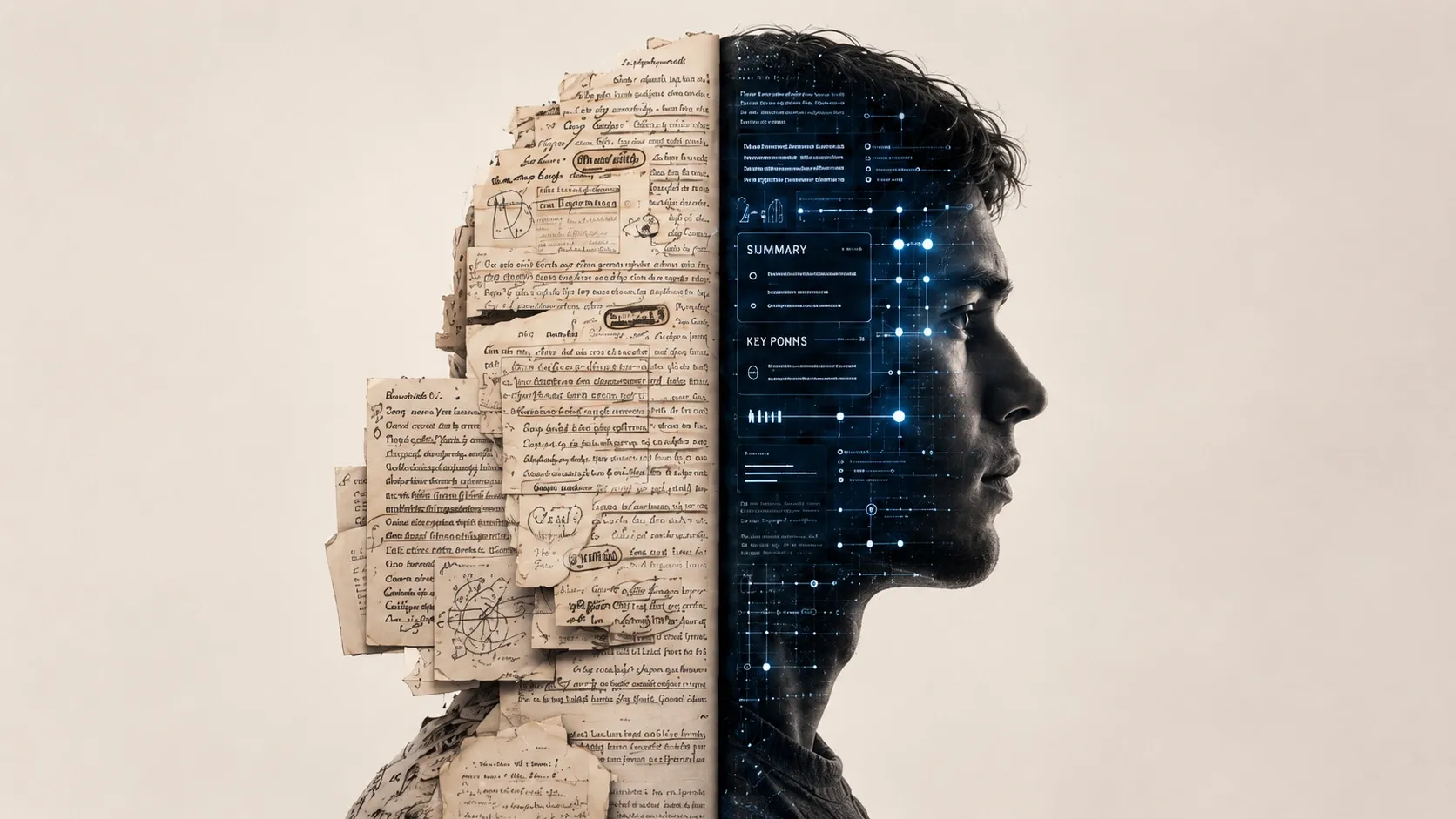
The great irony is that just as we weakened our cultural commitment to sustained human attention, we produced machines capable of consuming approximately everything ever written.
Sweet.
Welcome to the Machine.
The human doesn't want to read the book.
The machine has already read the book.
The human asks the machine what the book says.
The machine produces a perfectly reasonable approximation.
The student receives the information.
And something has disappeared.
Not necessarily the answer.
The journey.
The intellectual friction through which one encounters an idea, gets confused by it, misunderstands it, argues with it, carries it around for three days and eventually decides what one thinks.
That's difficult to outsource because the struggle is part of the education.
The Future of News Was Apparently Facebook
I remember attending a Future of News meetup around 2009.
Someone explained, apparently seriously, that more people were beginning to get important Chicago news through Facebook.
I thought it was almost a practical joke.
Why would anybody want an algorithm operated by a California technology company deciding which Chicago stories were worth knowing?
Well.
That joke ran for approximately the next decade and a half.
First came social distribution.
Then feeds.
Then engagement optimization.
Then influencers.
Then short-form video.
Then generative AI.
Each innovation removed a little more friction between the question and whatever answer happened to be waiting for us.
And every reduction in friction seemed like progress.
Until we began wondering why nobody trusted anything.
A newspaper may be imperfect.
A book may contain bias.
An editor may make mistakes.
A publisher may possess an agenda.
Fine.
But a printed object possesses a useful property in 2026:
Somebody put their name on the damn thing.
An author.
An editor.
A publisher.
A date.
An edition.
An artifact.
Something that can be challenged because something identifiable exists to challenge.
Compare that with the increasingly synthetic information environment headed our way.
Digital prose whose authorship is uncertain.
Pictures that never happened.
Video increasingly untethered from events.
Machine-generated citations.
Human-generated misinformation.
Machine-generated misinformation based upon human-generated misinformation.
Sweet.
But What About Abundance?
The fortunate among us can spend an extraordinary amount of time debating abundance.
How do children thrive emotionally?
How do we repair the social damage of COVID?
When should they receive phones?
What should we do about TikTok?
How much independence?
How much protection?
How much technology?
How much play?
Important questions.
Jonathan Haidt and others have turned attention itself into a central public-policy debate, while researchers continue arguing about the precise causal relationships between screens, social media and adolescent well-being.
Fine.
Keep debating.
But surely somewhere inside the abundance discussion we can reserve several hours a week for:
Read this.
All of it.
Come back Thursday.
We'll talk.
No machine required.
The Frontier Starts in the Classroom
Project Middle Ground spends considerable time talking about Chicago becoming a business-application leader in frontier industries.
Quantum.
Responsible AI.
Alternative medicine.
Cannabis.
Climate technology.
Whatever comes next.
Big bets.
Burnham-esque ambition.
Excellent.
But consider the absurdity of announcing that Chicago intends to compete with China, Silicon Valley, Boston and the rest of the world in technologies of breathtaking complexity while quietly accepting that our children can no longer be expected to finish a book.
If you cannot follow a novelist's argument for 300 pages, how exactly are you going to evaluate a 30-year industrial policy?
If you can't distinguish narrator from narrative, how are you going to interrogate an LLM?
If every uncomfortable idea requires an immediate swipe, how are you going to survive scientific uncertainty?
If a headline is sufficient, who needs journalism?
If the summary is sufficient, who needs the book?
If the model has the answer, who needs you?
There's the question.
Read No Small Books
Daniel Burnham famously told Chicago not to make small plans.
Fine.
Read no small books.
Not literally.
Short books are lovely.
The point is proportional ambition.
A city that wants to build the next century has to cultivate people capable of thinking beyond the next notification.
That requires technical literacy.
AI literacy.
Financial literacy.
Media literacy.
Scientific literacy.
Civic literacy.
And beneath all of them sits a much older technology:
Literacy.
Reading.
Writing.
Thinking.
Remembering.
Arguing.
A One-Party Town Particularly Needs Readers
Chicago and Illinois also possess relatively limited political competition at the moment.
Whatever your partisan preference, that increases—not decreases—the importance of competition elsewhere.
In classrooms.
Newsrooms.
Universities.
Boardrooms.
Community organizations.
Civic institutions.
A political ecosystem with limited electoral competition cannot afford limited intellectual competition too.
Readers encounter people who disagree with them.
Dead people, even.
There is no block button for Plato.
Dostoevsky does not care about your preferred news network.
Baldwin isn't checking whether his paragraph improves your sense of emotional safety.
History is filled with people who refuse to validate us.
Good.
We need them.
Back to School
So, here's a modest Project Middle Ground proposal for the 2026–27 school year.
Not another commission.
Not another app.
Not another AI framework containing 71 competencies.
Three things.
1. Read one difficult book all the way through.
Student.
Parent.
Teacher.
CEO.
Politician.
All of us.
Pick something slightly beyond your normal reach.
Finish it.
2. Print something important.
A newspaper investigation.
A long essay.
A speech.
Mark it up.
Write in the margins.
Argue with a physical object that cannot send you another notification.
3. Use AI after the first thought, not instead of it.
Ask the machine to challenge you.
Research.
Compare.
Edit.
Translate.
Explain.
Fantastic.
But occasionally make the human produce the question first.
Otherwise, we may eventually become exceptionally proficient at operating tools whose purposes we are no longer intellectually equipped to interrogate.
The Epic Continues
Technology doesn't remove human agency.
It tests it.
Schools have agency.
Teachers have agency.
Parents have agency.
Students certainly have agency.
Trustees do.
Universities do.
Media organizations do.
Politicians do.
And those of us walking around complaining about everybody else's attention span have agency too.
Buy the newspaper.
Read the book.
Leave the phone in another room.
Ask the kid what she thinks instead of what ChatGPT thinks.
Then let her use ChatGPT.
See if the machine changes her mind.
Maybe she'll change the machine's answer.
That would actually be education.
Chicago's ambition should always be Burnham-esque.
Build the quantum computers.
Train the AI models.
Explore new medicines.
Reinvent the classroom.
Compete globally.
Make no small plans.
Yes, and…
Somewhere along the heroic journey, flip through a tragedy.
A history.
A comedy.
Something old.
Something difficult.
Something printed, bounded and stubbornly unwilling to scroll.
Because before we outsource humanity's accumulated knowledge to machines, it would be useful if the humans remembered how to read some of it themselves.
Back to school.
The bell is ringing.
You still have agency.
Project Middle Ground
Literacy. Media Ecology. Frontier Industry. Follow-Up Questions