
Chicago Between Acts

The Lucas Museum of Narrative Art finally opened in Los Angeles.
Chicagoans know the backstory. George Lucas and Mellody Hobson once wanted to build the museum here. We fought about the lakefront, process, privilege and precedent. Los Angeles got the spaceship.
Maybe that was the right outcome. Maybe it was a historic fumble. Maybe both things can be true.
That feels like Chicago right now.
We are somewhere between Acts II and III.
Act II is when the heroes are scattered, institutions fail, alliances fracture and nobody can quite see the ending. It is also when everyone becomes very sure who the villain is.
Exhibit A arrived this week.
Ken Griffin, who built much of Citadel’s wealth in Chicago before leaving for Miami, gave Carnegie Mellon more than $3 billion — the largest individual gift in higher-education history. Two billion dollars will help create a new 35-acre CMU campus in Miami’s Wynwood neighborhood; another billion goes to Pittsburgh, including a Kenneth C. Griffin School of Computer Science.
Chicago helped make the fortune. Miami gets a university.
It is tempting to make Griffin our Darth Vader. But that is too easy.
He also gave enormously to Chicago, including $125 million to what became the Griffin Museum of Science and Industry, while becoming furious with Illinois and Chicago leadership over crime, taxes and governance. At times his rhetoric about the city overwhelmed legitimate criticisms beneath it. At times Chicago politics seemed determined to prove his point.
Vader, remember, was complicated too.
Then there is Bob Clark.
This week Forbes profiled the Clayco founder riding from the Obama Presidential Center in Jackson Park toward the old U.S. Steel site, where a new quantum-and-AI future is being assembled. Penny Pritzker praises him. Data centers are booming. Forbes estimates Clark’s fortune at roughly $7 billion, roughly three times what it was three years ago.
Chicago’s past and future are eleven miles apart, and Clark is driving between them.
But the same story contains the tension underneath all this building: power, water, land, fortunes, public subsidy and understandable questions about who benefits from AI infrastructure that most people barely understand.
That question cannot end with the kid in Roseland, although it must include the kid in Roseland.
It also includes the investor from somewhere else who likes Chicago, sees opportunity here and does not want participation to require entering a political family feud.
And it includes people more like me: the professional class I chose to join as an adult. We live in places like Lakeview. We are secure. We have access to information, healthcare, travel, restaurants, universities and technology that would have seemed miraculous to earlier generations.
We are also busy, twitchy and increasingly unsure what any of it means.
We love Chicago. We just don’t always know how to belong to it anymore.
The middle is not a socioeconomic class.
It is the place where all these people still have to meet.
That may be the part we have forgotten.
For more than a century, Chicago’s superpower was not agreement. It was productive collision. Burnham dreamt too big. Industrialists accumulated obscene fortunes. Labor fought them. Immigrants remade neighborhoods. Black Chicago created institutions while confronting exclusion. Reformers challenged machines while sometimes building machines of their own.
The city argued — and built.
The next version cannot simply recreate 1893 with better broadband.
The Crystal Palace has to admit the whole city this time: Black, Latino, Asian, white, immigrant, queer, old, young, rich, poor, South Side, West Side, North Side, suburban, newly arrived and multigenerational Chicago.
The question is whether we can recover the appetite for building enormous things while expanding who gets to build them and who benefits afterward.
As I write this, Beck’s new Ride Lonesome is playing.
He reconvened musicians who played with him on Mutations, Sea Change and Morning Phase. Beck described returning to the same people and studio decades later and finding that the chemistry had “evolved and deepened.”
Return without regression.
There is something in that for Chicago.
And, embarrassingly, something in Han Solo for me.
Han begins as a smuggler. Transactional. Skeptical. Flying a beat-up machine, carrying other people’s cargo, trying to stay solvent and not get pulled into anybody else’s crusade.
Journalism can feel like that.
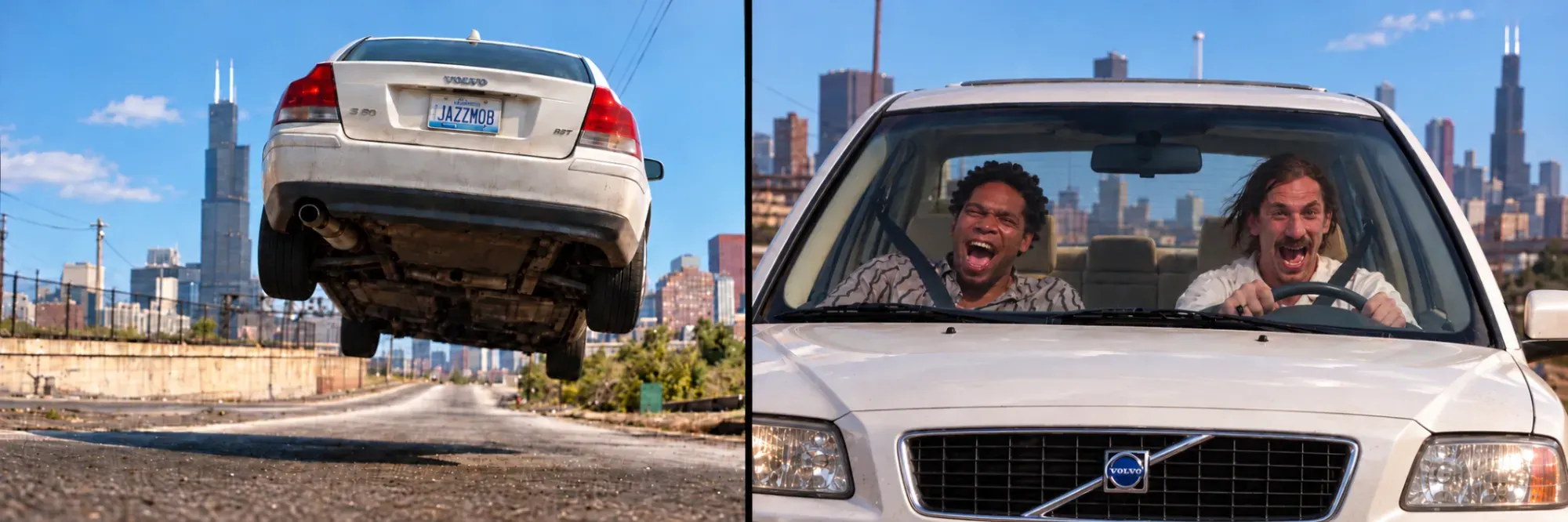
For years I have driven my own Millennium Falcon — a 2004 white Volvo known as the Jazz Mobile — between technology people, politicians, entrepreneurs, activists, professors, cannabis operators, corporate executives and neighborhood voices, carrying information between worlds that often do not talk.
The hyperdrive is unreliable on the Kennedy.
But maybe transporting the cargo is not enough.
Han’s moral arc is not that he becomes pure. He decides that some things are worth showing up for even when nobody is paying him to make the run.
That is the rebellion I am interested in.
Not left against right. Not business against government. Not neighborhoods against downtown.
A rebellion against the idea that disagreement requires estrangement.
The Bears are asking us to believe that a plan and an over-the-hill third-string warrior might still produce victory. The Cubs have been eliminated from the playoffs. And the White Sox are now Bound for Glory and Partying Like It’s 2005.
So perhaps hope is already irrational enough to qualify as a Chicago strategy.
Lucas built his museum somewhere else.
Griffin is building his university somewhere else.
Clark is building his quantum future here.
None of those facts tells us whether Chicago wins.
Act III is not about winning.
It is about deciding who is coming with us.
For all the billions, battles and big plans, maybe the constituency that matters most is whoever inherits the city after we are finished arguing about it.
My son is part of that constituency.
So is the kid in Roseland.
So is the investor arriving from somewhere else.
So is the person in Lakeview who loves this city, has built a life here and still wonders what belonging to it is supposed to mean.
The Falcon is still flying.
The ending is still ours to write.
Punch it.